Three issues behind one security update
On October 14, 2026, the Next.js team released a security update covering two critical remote code execution vulnerabilities and a high-severity denial-of-service vulnerability. The announcement named Next.js 16.4.1 and 15.5.28 as patched releases for the supported branches. These are the fixes identified in that announcement, rather than a permanent recommendation to install those exact versions. Official Next.js announcement.
The three issues involve different parts of an application. Understanding those differences helps explain what needs checking and why an upgrade matters.
| Issue | Relevant application features or environment |
|---|---|
| Cache Components RCE | App Router with a cached function returning multiple typed arrays |
| Image Optimization RCE | SVG processing through the affected image pipeline on glibc-based Linux |
| Server Actions DoS | App Router with at least one Server Action |
These conditions come from the individual advisories. They describe the affected paths; they do not replace the maintainers’ upgrade guidance. Cache advisory, image advisory, Server Actions advisory.
Cache Components: the return value matters
The Cache Components advisory, GHSA-673q-mjm6-r5xr, describes unauthenticated remote code execution in App Router applications where a use cache function returns multiple typed arrays.
It lists Next.js 16.0.0 through 16.4.0 as affected, with a fix in 16.4.1. The maintainers report no known workaround for affected applications and explicitly recommend upgrading even when an application does not appear to contain similar functions. Next.js Cache Components advisory.
That final instruction matters. Searching the codebase for typed arrays can help explain exposure, but an incomplete search should not become a reason to postpone the patch.
The related React advisory covers the react-server-dom-* packages. This also makes the dependency picture more specific than checking the version of the top-level react package alone. Framework integrations and their server-rendering dependencies belong in the review. React Server Components advisory.
Image Optimization: deployment details matter too
The image-processing issue, GHSA-2464-fhr4-w9xw, concerns SVG handling in the Image Optimization API. The advisory describes a memory-related vulnerability in an upstream library that can lead to remote code execution when Next.js runs on glibc-based Linux.
Its documented workaround is to ensure that the sharp version used by Next.js is at least 0.35.5. Upgrading to the patched Next.js releases ensures the package manager can provide a fixed sharp version. Next.js Image Optimization advisory.
Here, the useful questions extend beyond whether the repository contains an SVG file. Which image-processing path handles incoming images? What dependencies were resolved during the build? Which operating environment runs that build?
A version range in package.json provides only part of that information. The lockfile and deployed artifact help establish what the application actually uses.
Server Actions: a small application can still qualify
The third issue, GHSA-p3m5-59mp-jv5r, affects App Router applications with at least one Server Action.
Crafted requests can cause excessive CPU usage, preventing the same process from handling further requests. The advisory lists affected releases across Next.js 13–15 and 16, with fixes in 15.5.28 and 16.4.1 respectively. It states that Pages Router applications and applications without Server Actions are not vulnerable to this particular issue. Next.js Server Actions advisory.
A dashboard does not need hundreds of actions to meet the stated condition. A single content-editing action is enough to make this advisory relevant to an otherwise small application.
The related upstream React advisory documents the Server Functions denial-of-service issue. Reading both helps connect the framework-level guidance with the dependency where the underlying behavior is addressed. React Server Functions advisory.
How this relates to Storylio
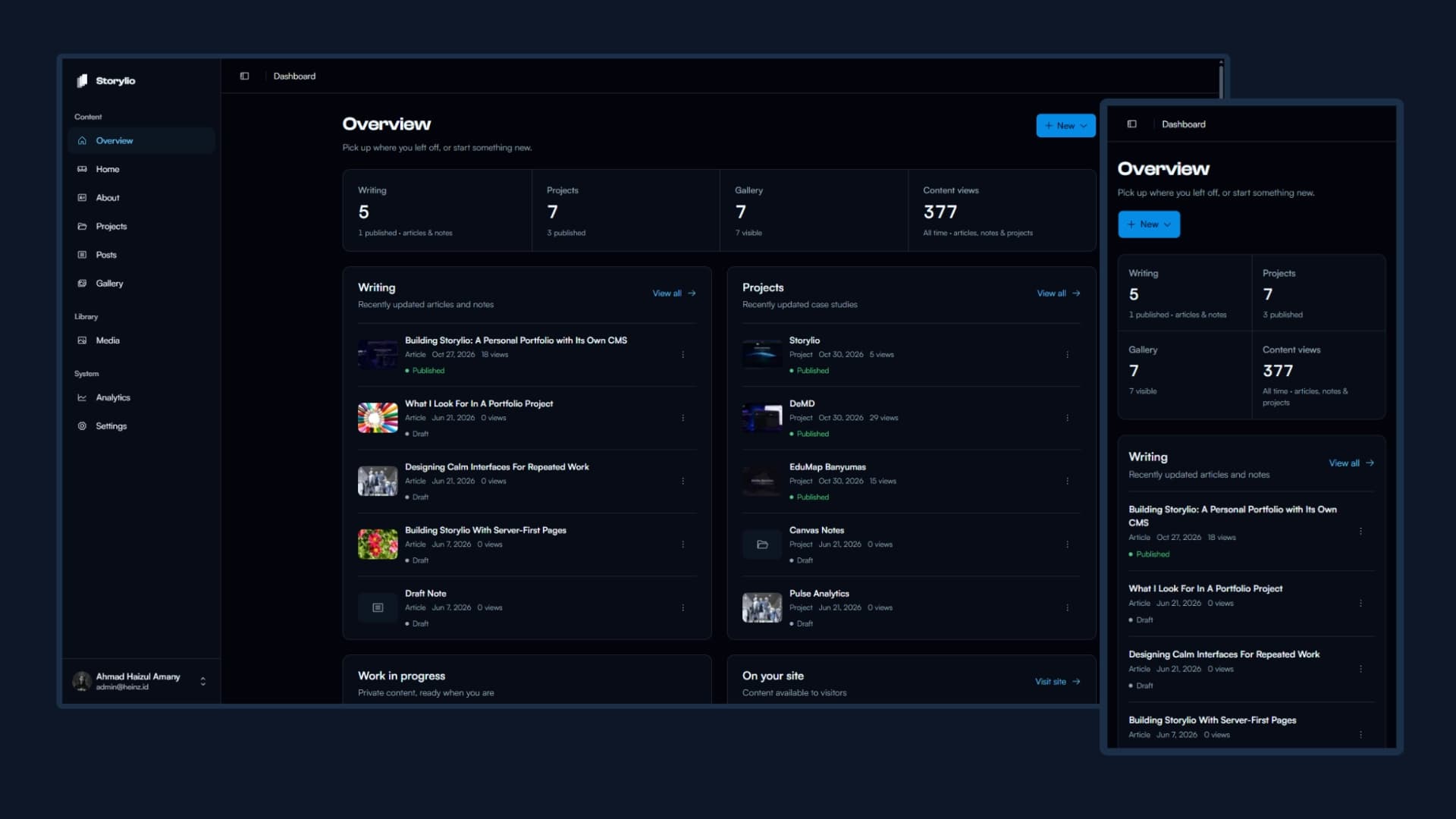
Storylio uses App Router, enables Cache Components, and has Server Actions for managing content. Those features make the October update relevant to the project.
At the time of writing, its package manifest specifies Next.js 16.4.2 and a sharp range starting at 0.35.5. That places the declared Next.js version after the patch release discussed here.
I would still separate that observation from a claim about every running deployment. A repository can be updated while an older deployment remains active. Confirming the build and rollout is part of completing the update.
There is also a difference between identifying a relevant advisory and demonstrating exploitation. This article explains the published conditions; it does not claim that Storylio was compromised or that an exploit was reproduced against it.
A practical review after the announcement
For an application using these features, a useful review follows the change through to deployment:
- Read the individual advisories. Record the affected features, version ranges, and documented workarounds.
- Check resolved dependencies. Review the lockfile alongside the manifest, including the image-processing dependency used by Next.js.
- Upgrade to an appropriate patched release. Check current maintainer guidance rather than treating October’s patch versions as the newest available indefinitely.
- Build and exercise the relevant workflows. Check cached public pages, image loading, and forms that use Server Actions.
- Confirm the deployment. Make sure the new artifact is serving traffic and inspect errors after rollout.
Passing application tests provides evidence that the upgrade preserved expected behavior. It does not establish that every vulnerability has been independently tested.
Read the conditions, then finish the update
The useful detail in this release is how differently the three issues depend on application behavior and infrastructure.
A cache function’s return value matters in one advisory. An image-processing dependency and Linux environment matter in another. The presence of a Server Action matters in the third.
Reading those conditions makes the response more precise. The work is complete when the appropriate patched dependencies have reached the running application and its important workflows still behave as expected.
Sources checked October 30, 2026. Consult the linked maintainer advisories for subsequent revisions.